
Harsh Environment
Hydrostatic vs electronic load cells: how the two weighing systems compare
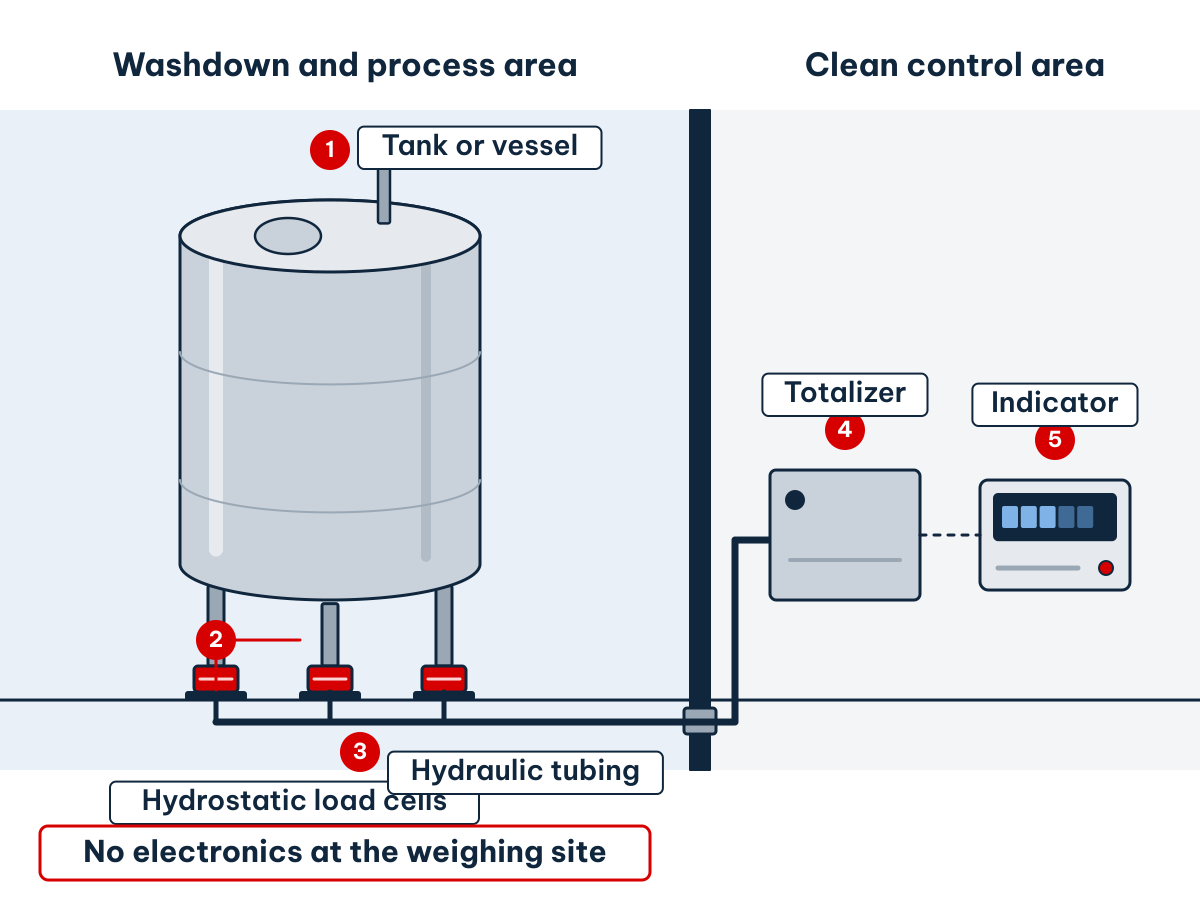
The same tank on the same supports — two different ways to weigh it. Sketch 1 shows the electronic system; Sketch 2 shows the hydrostatic system. Here is what changes, and what it means in a harsh environment.
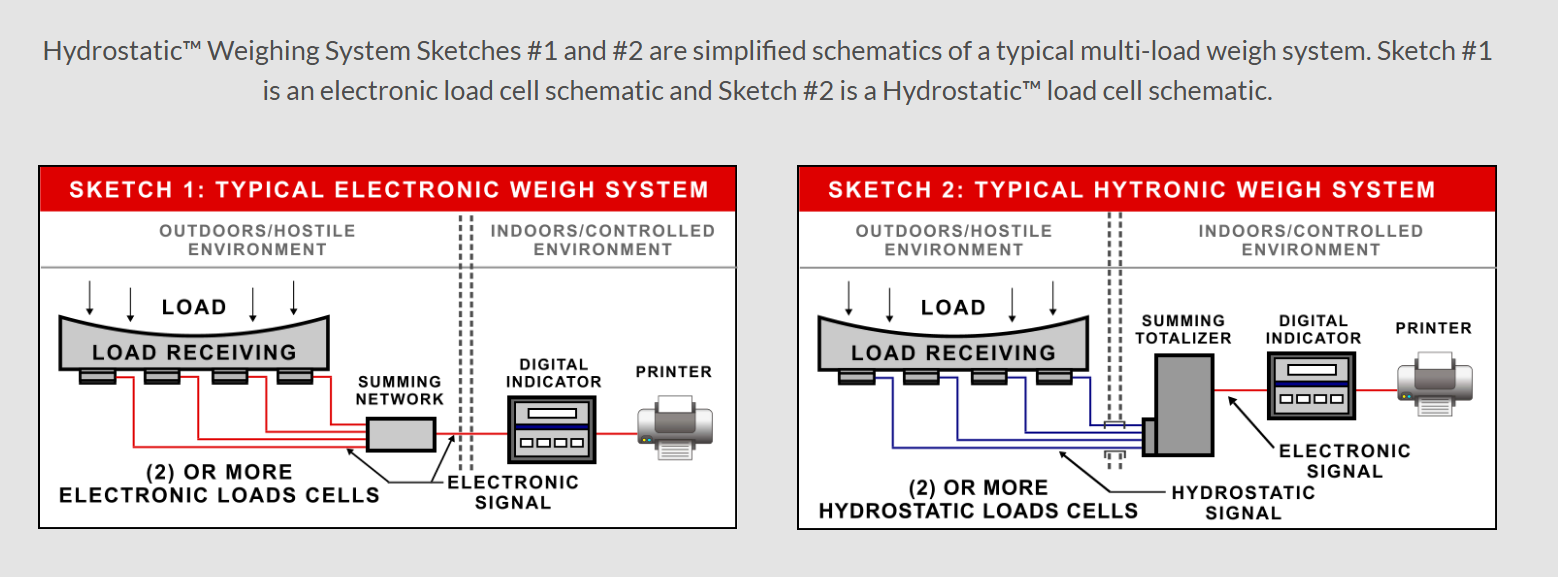
A multi-load-cell weigh system has the same job in both sketches: weigh the load on the load receiving frame and report it at the digital indicator and printer. The difference is what sits outside, in the hostile environment, and what kind of signal travels indoors. Sketch 1 is an electronic load cell schematic and Sketch 2 is a Hydrostatic™ load cell schematic — the sketches are Emery Winslow Scale’s own.
The signal path, side by side
Read the two sketches from left to right: the load, the cells, the signal, the indicator.
| Electronic weigh system (Sketch 1) | Hydrostatic weigh system (Sketch 2) | |
|---|---|---|
| Load cells | (2) or more electronic load cells under the load receiving frame | (2) or more hydrostatic load cells under the load receiving frame |
| Signal from the cells | Electronic signal — cables from each cell to a summing network | Hydrostatic signal — fluid lines from each cell to a summing totalizer (force frame) |
| Indoors | Digital indicator and printer, fed directly by the electronic signal | Transducer (mV output) converts the hydrostatic signal to an electronic signal for the digital indicator and printer |
| What sits in the hostile environment | Strain-gauge sensors, cables and summing electronics | Sealed hydrostatic cells and fluid lines — no electronics at the sensing point |
| What water, lightning or surges hit first | The sensor and its electronics, exactly where the load is | The sealed cell body and fluid lines; the electronics sit indoors, in a controlled environment |
| Sensor construction | A metal spring element with bonded foil strain gauges, wired as a Wheatstone bridge | A sealed pressure capsule: a piston and diaphragm over a fluid-filled chamber — no electrical parts at all |
| Junction boxes & cabling | A junction (summing) box at the scale, corner trimming, and home-run signal cables to the indicator | Fluid tubing to a summing totalizer — no electrical connections outdoors |
| Cell body materials | Alloy steel or stainless steel; hermetic sealing available | Stainless steel (304 standard), with 316, titanium, Monel and Hastelloy options for corrosive duty |
| Routine maintenance | Calibration and corner checks, box and cable inspection, planned cell replacement in harsh duty | Little at the scale; service concentrates on the indoor totalizer, transducer and indicator |
Inside the two sensors
Start with the sensing element itself, because everything else in this comparison follows from how each cell is built.
The hydrostatic cell is a pressure capsule. In Emery Winslow’s design, the load bears on a piston that presses on a sealed, fluid-filled chamber closed by a diaphragm. The pressure that builds in the fluid is exactly proportional to the load, and that pressure — not an electrical signal — is the cell’s output. Construction varies by duty: the 120 Series uses a fabric diaphragm that a plant mechanic can replace if a cell is damaged by a severe side load, while the larger 136 Series uses a stainless steel diaphragm welded in place. There are no gauges, wires or circuit boards inside; the cell is, in the manufacturer’s words, totally non-electronic.
The electronic cell is a measuring instrument. A machined metal spring element flexes by a minute, repeatable amount under load; foil strain gauges bonded to it change resistance as they stretch and compress; a Wheatstone bridge turns that change into a millivolt signal. The gauges, their adhesive bonds, the internal wiring and the cable entry are all part of the cell — and all of them live where the load is: under the tank, in the pit, beneath the weighbridge deck.
Junction boxes and cabling: what the sketch simplifies
Sketch 1 draws the electronic system’s summing network as a single box. On a real scale it is a small electrical installation at the weighing point: a junction (summing) box where every cell’s cable terminates, trimming components that balance the corners against each other, glands and seals where each cable enters, and home-run cabling carrying millivolt signals to the indicator. Every one of those is a place water can enter, and a connection that can corrode, loosen, or carry a surge in from the scale. Six-wire sense cabling and surge protectors reduce those risks; they do not remove the parts.
The hydrostatic equivalent in Sketch 2 is a run of fluid tubing to a summing totalizer. Tubing holds no electrical connections to corrode, carries no signal a surge can ride on, and can be hosed down, buried or submerged along with the cells. The system’s one electronic conversion — the transducer that turns totalized pressure into a millivolt signal for the indicator — happens indoors, at the totalizer.
What fails, and where
The electronic system puts its most sensitive parts exactly where the damage happens: under the tank, in the pit, beneath the weighbridge deck. Water, flooding, lightning and corrosion kill electronic load cells — the published case studies show the pattern: high-pressure washdown every night at Plumrose and Morgan Foods, pits that flood at Boar’s Head, lightning at Rogers Group and Redland Stone.
In the hydrostatic system the sensing point has no electronics at all: sealed cells and fluid lines. The manufacturer states its hydrostatic load cells are fully non-electronic and carry a guarantee against failure from water, high-pressure washdown, condensation, humidity, submersion, power surges, static charges, welding surges and lightning (Plumrose case study). The electronics that remain — the transducer, the digital indicator — sit indoors, in a controlled environment.
Environment by environment
Washdown. High-pressure water and detergents are a daily event in food, beverage and aquaculture plants. For an electronic system, every washdown tests the junction box seals and cable glands; failure is a matter of cycles. A hydrostatic cell has no seals to test — washdown is on Emery Winslow’s lifetime guarantee list.
Flooding and submersion. Pits fill in the monsoon; some tanks stand in water permanently. Electronic cells rated for immersion exist, but their cables and junction boxes must be rated and installed to the same standard, and one compromised gland floods the summing network. Hydrostatic cells work submerged — at SeaWorld, permanently — because water pressure outside a pressure capsule changes nothing inside it.
Lightning and power surges. A weighbridge is a large metal structure wired to a building: a surge path by design. Surge protection diverts much of the energy, but the electronic chain — cells, box, indicator — is what the remainder reaches. In a hydrostatic system the outdoor run is a fluid line; there is no electrical path from the scale to the building at all, and lightning damage to the cells is, again, on the guarantee list.
Corrosion and chemicals. Fertiliser dust, acid splash, brine and coastal air attack cable insulation, connectors and cell bodies. Stainless and alloy options exist on both sides (see Materials, above); the difference is how many parts are exposed — a capsule and tubing, or a capsule-sized sensor plus its cable, gland and summing box.
Dust and abrasion. Cement and quarry dust is conductive, abrasive and everywhere. It harms electronic systems mainly by entering enclosures and by coating connections; it harms a hydrostatic cell not at all, because there is nothing to enter.
Hazardous areas. Where flammable gas or dust may be present, the relevant question is certification — of the exact equipment, for the exact zone — not technology slogans. A hydrostatic cell holds no electrical energy at the sensing point, which removes the scale as an ignition source; what that means, and what it does not mean, is set out on HearS’s oil, gas & LPG page. HearS claims no explosion-protection certification for this equipment, because none has been verified for it.
One system, many load cells
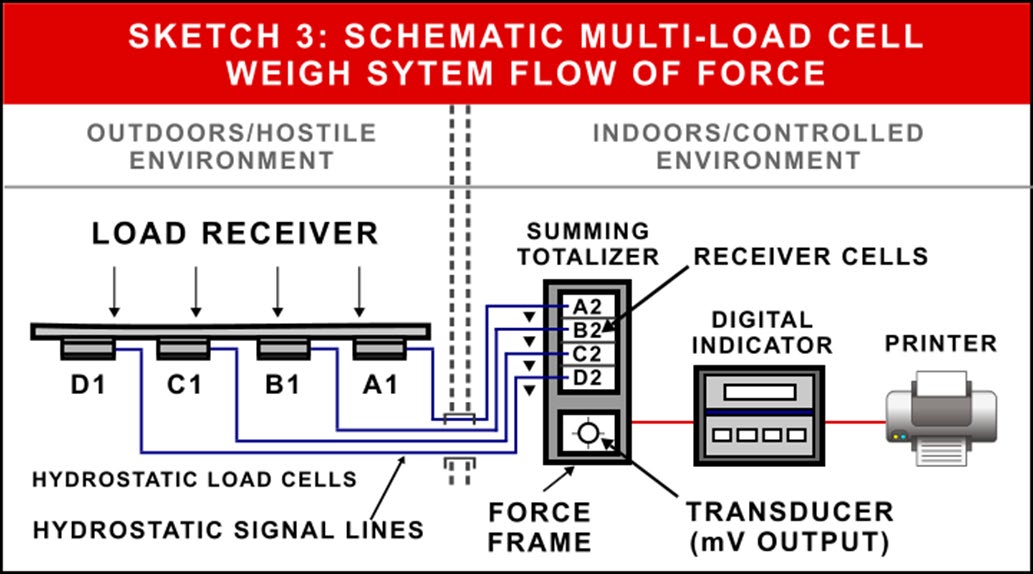
Sketch 3 shows the same idea with four cells (D1, C1, B1, A1) under one load receiving frame: hydrostatic signal lines run from each cell to a single summing totalizer on the force frame, then a transducer (mV output) feeds the digital indicator and printer. Adding cells does not add electronics outdoors — the outdoor part stays sealed cells and fluid lines.
Installation and calibration: shared homework
Neither sketch shows a foundation, and both systems stand or fall on one. A tank must be free to settle its weight onto the cells — piping restrained flexibly, supports level, side loads and thermal expansion allowed for. A weighbridge needs its approaches straight and its pit drained or deliberately flooded-proof. Get the mechanics wrong and either technology will weigh badly; get them right and both will weigh well.
The installation work differs in kind. An electronic system needs cable routes protected from traffic and rodents, junction boxes mounted where they can be reached and kept sealed, and corner trimming at commissioning. A hydrostatic system needs tubing routes protected like pipework, a totalizer position indoors, and the lines filled and bled correctly at commissioning. HearS’s part in both cases is the same: survey the site, design the mechanics, install, commission, and verify with test weights before handover.
Calibration, finally, is not a difference between the technologies. Both are adjusted and verified against test weights or a calibrated reference, both drift if the mechanics around them change — a bent stay rod or a repacked pipe flange will move either system’s reading — and both belong on the plant’s calibration schedule. The difference is what else the schedule has to cover: for the electronic system, the health of the whole electrical chain; for the hydrostatic system, essentially the indoor instruments alone.
What the sketches do not show
Neither sketch shows installation, calibration or maintenance — both systems need all three, done properly. A hydrostatic system still needs its transducer and indicator indoors, and a site with a dry, controlled environment may weigh perfectly well on electronic cells. The sketches answer one question only: what happens when the environment turns hostile — and that is the question to ask first when the scale will be washed down, flooded, or struck by lightning.
Accuracy, response and capacity
Correctly installed, both technologies weigh accurately enough for trade and process control, and both are verified the same way: with test weights, on a calibration schedule. Their characters differ. A hydrostatic system measures pressure, and pressure does not drift the way a strained gauge and its cabling can — its long-term stability is the reason cells stay in service for decades. An electronic system responds almost instantly, which makes it the natural choice for high-speed and dynamic weighing. On capacity, Emery Winslow offers hydrostatic vessel systems from about 1,000 lb to 1,000,000 lb; electronic cells cover the widest total range in weighing, from laboratory grams to heavy industrial capacities.
Materials: what the cell body is made of
Because a hydrostatic cell is a simple pressure vessel, its body can be specified for the chemistry around it. Emery Winslow builds its hydrostatic cells in stainless steel — grade 304 as standard — with 316 stainless, titanium, Monel and Hastelloy options for corrosive duty: the same options HearS lists for oil, gas and chemical service. The exact material is confirmed in the quotation for the duty in question; the point is that nothing in the cell’s construction prevents it.
Electronic cells are built from alloy steel or stainless steel, with the strain-gauge area protected by potting, bellows or hermetic welding. A hermetically sealed stainless electronic cell is genuinely water-resistant. The real limitation is the system around the cell: the cable, its entry gland and the junction box remain the usual failure points in wet service, whatever the cell body is made of.
Maintenance in practice
Hydrostatic systems ask for little at the scale: there is nothing to recalibrate at the cell, no corner trimming outdoors and no cell-replacement cycle. Maintenance concentrates indoors — the totalizer, its transducer and the indicator — plus periodic checks that tubing is undamaged, and verification with test weights on the plant’s normal calibration schedule. If a 120 Series fabric diaphragm is ever damaged, a plant mechanic can replace it; and Emery Winslow guarantees the cells themselves for life against failure from water, flooding, humidity, washdown, lightning and power surges.
Electronic systems ask for a routine: scheduled calibration and corner checks, inspection of junction boxes and cable insulation, pits kept drained and boxes kept sealed — and, in harsh duty, planned replacement of cells as they drift or fail, with spares matched to the installed type and capacity. None of this is unreasonable, and in a dry plant it is a small price. In a wet, corrosive or lightning-prone plant it is a recurring cost that belongs in the comparison from the start.
Limitations of both technologies
Neither technology is universally better, and a credible comparison acknowledges that from the start.
Hydrostatic limitations. The system still ends in electronics — a transducer and an indicator that need a clean, dry home indoors. Fluid lines must be routed and protected like any pipework. First cost is typically higher than a basic electronic system; very high-speed dynamic weighing is the electronic system’s home ground; and hydrostatic weighing is a specialist technology from a small number of manufacturers, Emery Winslow foremost among them.
Electronic limitations. The sensing point is electrical, so the environment attacks the measurement itself: moisture ingress, corrosion, surge and lightning damage, signal drift, and a finite cell life in harsh duty. Accuracy depends on the whole chain — cell, cable, junction box, indicator — staying healthy, and maintenance is a permanent line item rather than an occasional one.
Which system fits your site?
If the scale will face washdown, flooding, condensation, lightning or hazardous areas, start from the hydrostatic system — then confirm the scope, the interfaces and the documents with HearS. If the environment is dry and controlled, an electronic system can be the right fit, and HearS will say so. HearS’s page on electronic load cell systems explains that technology in the same detail as this comparison. Either way, the quotation confirms the scope, the schedule and the applicable standards.
Keep reading
What makes an environment harsh for a scale?
A plain-language definition of harsh and hazardous environments for industrial weighing: washdown, flooding, c…
Read the article: What makes an environment harsh for a scale?Hydrostatic weighing for harsh environments — delivered in Vietnam by HearS
How Emery Winslow Scale Hydrostatic™ load cells (120 and 136 Series LifeMount) answer washdown, flooding, ligh…
Read the article: Hydrostatic weighing for harsh environments — delivered in Vietnam by HearSIndustrial Harsh Environment weighing solutions
The HearS solution hub: definitions, case studies and Hydrostatic™ technology.
Read the article: Industrial Harsh Environment weighing solutions
Need help with this?
Tell us about your application and we will reply by email.