
HearS Dak Lak branch · Demonstrated at several sites; available now
Off-grid irrigation – HearS Dak Lak branch
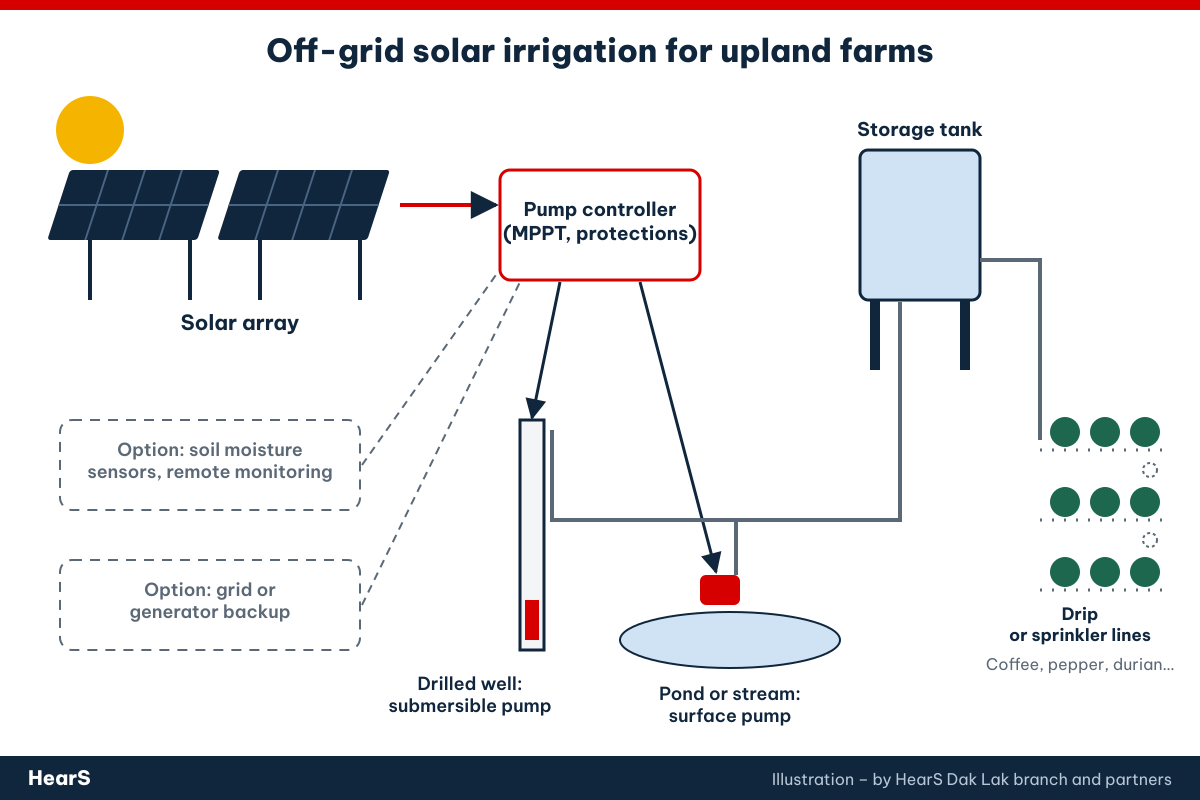
For coffee, pepper, durian and other upland farms in the Central Highlands where mains power is far away or unreliable: the sun drives the pump, so there is no diesel to buy and no generator to run. The HearS Dak Lak branch surveys the farm, sizes the system and installs it with its partners.
Status: demonstrated at several sites; available now
This is the solution of the HearS Dak Lak branch. It has been demonstrated at several sites and is available now; each system is sized for the farm after a survey and confirmed in the quotation.
Why irrigate with solar power
No mains power needed
The pump runs on the solar array, so plots far from the grid can still be irrigated.
No fuel to buy
No diesel to buy, carry or store; no generator noise or exhaust.
Runs by itself
The controller starts and stops the pump with the sun and protects it, for example against running dry.
Water where the roots are
Drip or sprinkler lines from a storage tank deliver water along the rows.
How the system works
Solar array
Produces DC power during the day.
Pump controller
Tracks the maximum power of the array (MPPT), drives the pump and protects it: dry running, overvoltage and undervoltage, overcurrent, overheating, surges.
Pump
A submersible pump for a drilled well, or a surface pump for a pond, lake or stream.
Tank and irrigation lines
Water is stored in a tank and distributed by drip or sprinkler lines; it can also supply livestock or household water.
Options
Soil moisture sensors and remote monitoring; grid or generator backup for cloudy periods.
Mounting the solar array
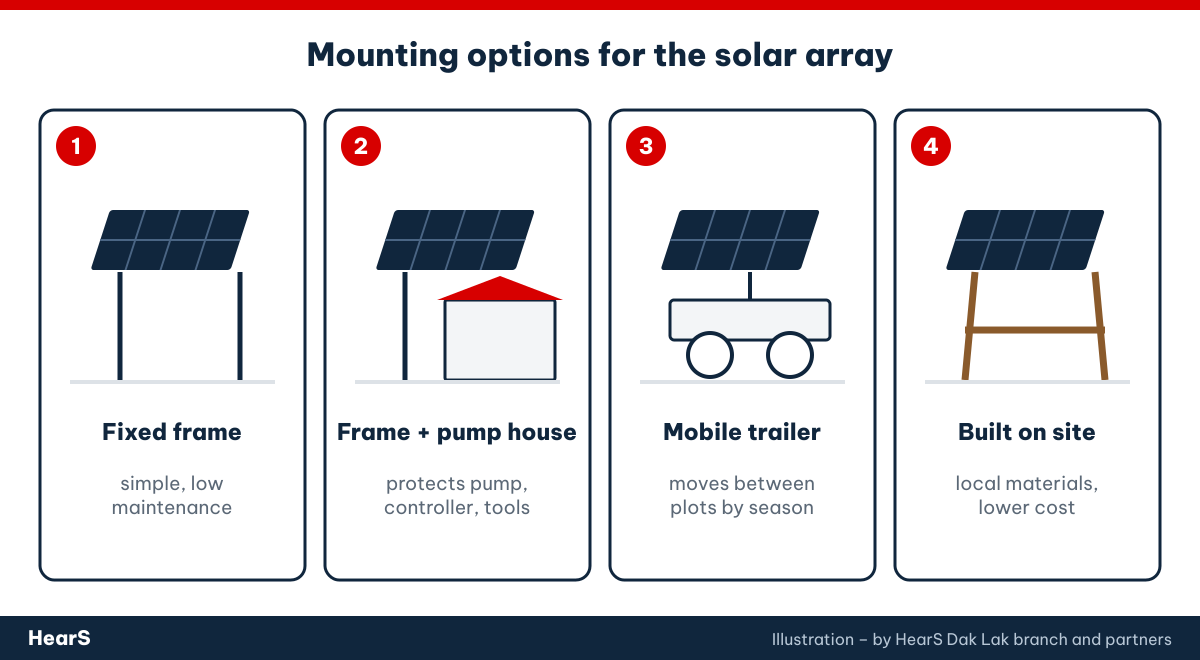
The frame is chosen at survey: a fixed frame (simple, little maintenance); a fixed frame with a pump house that also shelters the pump, controller and tools; a mobile frame on wheels for farmers who move between plots by season; or a frame built on site with local materials to lower the cost.
Illustrative example: what a diesel pump costs to run
Illustrative example only, to show how to compare. Use your own pump's fuel use, hours and the local fuel price.
| Item | Example | Note |
|---|---|---|
| Fuel use of a small diesel pump | 1.5–2 litres per hour | Assumption; check your engine |
| Running time | 8 hours per day | Assumption |
| Fuel per day | 12–16 litres | = fuel use × hours |
| Fuel cost per day | litres per day × local price | Fuel for a solar pump: none |
A solar system costs more to buy than a diesel pump; HearS compares purchase and running costs for each farm in the quotation.
What HearS needs for sizing
- Crop, area and number of trees
- Water source: drilled well (depth, diameter) or pond, lake, stream
- Water needed per day and the height to the tank or field
- Existing irrigation lines and any power on site
- Province and district
Based on a solar water pumping product brochure provided to HearS (June 2026), summarised without brand or model names. Figures are illustrative; pump, controller, array size, warranty and price are confirmed for each farm in the HearS quotation.
Planning irrigation for your farm?
Requests go to the HearS Dak Lak branch: hearsdaklak@gmail.com.
Prefer to talk it through? Send us a photo of your current scale by email — and HearS will advise before any quotation.